Taipei, Taiwan, - July 17, 2025
Areca today officially unveiled its next-generation
NVMe hardware RAID adapter, the ARC-1689-8N, featuring PCIe Gen5 technology,
eight M.2 NVMe slots, and advanced hardware RAID capabilities. This fastest and
reliable solution delivers unprecedented storage performance for high-performance
computing (HPC), artificial intelligence (AI), and machine learning (ML) applications.
Highlights of ARC-1689-8N:
-
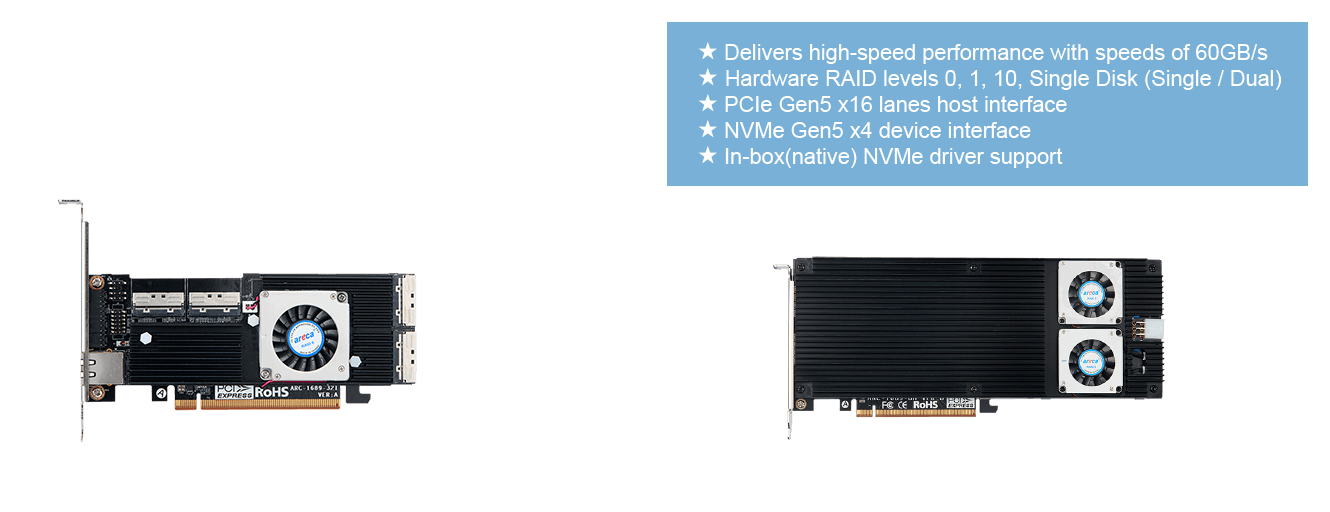
PCIe Gen 5.0 x16 lane host interface
-
Support for 4x 2280 and 4x 22110 form factor M.2 NVMe drives
-
64GB/s bandwidth and sustained transfer speeds up to 60GB/s
-
Support hardware RAID 0, 1 (Simple/Multi Mirroring), 10, single disk(single/dual/triple), and JBOD
-
Support off module power loss protection (PLP)
-
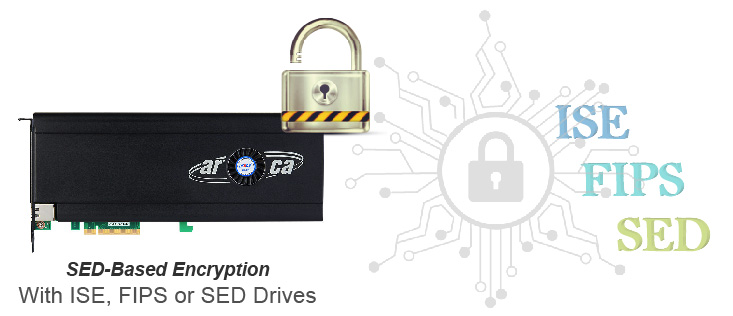
SED support for hardware NVMe encryption capable drives
-
Support for UEFI secure boot
-
Support in-box (native) NVMe driver
-
Advanced, intelligent thermal solution to control fan speed
Breakthrough Performance and Innovation
The ARC-1689-8N is designed with the PEX89048 Gen5 48-lane switch and robust
RAID engine. . Its PCIe Gen5 x16 host interface ensures up to 64GB/s of bandwidth
and 60GB/s sustained transfer rates. This adapter also features with eight Gen5 x4
M.2 NVMe slots (compatible with 4x 2280 and 4x 22110 form factors), providing the
high-density storage capacity required for demanding, large-scale multi-adapter
configurations.
Hardware RAID & Data Protection
Unlike software RAID, the ARC-1689-8N significantly reduces host CPU and memory
overhead by leveraging a robust hardware RAID acceleration, which supports RAID 0,
1 (Simple/Multi Mirroring), 10, single disk (single/dual/triple), and JBOD. Its Power
Loss Protection (PLP), enabled by the optional ARC-1886-CBM supercapacitor
module, ensures data integrity during sudden power failures by safely flushing
internal data from NVMe DRAM to NAND flash. This not only protects your data but
also lowers costs by eliminating the need for SSD-internal capacitors.
Enterprise-Grade Security & Features
This adapter delivers comprehensive data security for data centers and enterprise
users. It supports UEFI Secure Boot and hardware secure boot via its onboard PCIe
switch. The adapter additional features include NVRAM event logging, redundant
firmware images, and compatibility with NVMe TRIM/S.M.A.R.T. commands and
self-encrypting NVMe drives (SED), ensuring the data is protected.
Advanced Cooling & Broad Compatibility
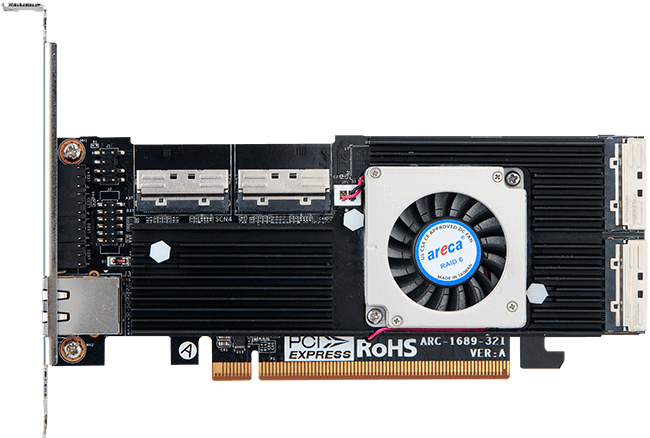
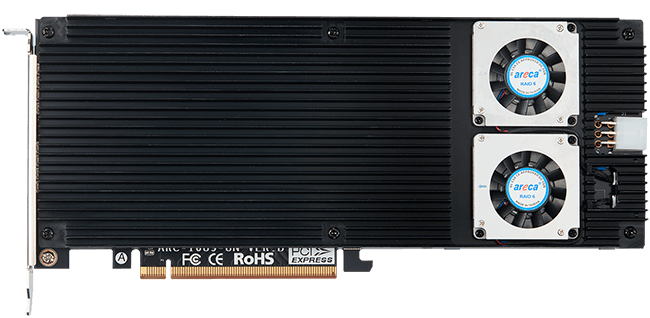
To address thermal challenges in high-performance storage, the ARC-1689-8N
employs a full-length aluminum heatsink and two low-profile cooling fans, keeping
M.2 NVMe SSDs within optimal temperature ranges. The ARC-1689-8N is compatible
with in-box (native) OS NVMe host drivers. It is backward-compatible with PCIe
3.0/4.0 and supports x1 to x16 signal modes. Stable power is delivered via a
dedicated 6-pin PCI-E power connector.
Intuitive Management & Monitoring
RAID management is simplified with the McBIOS RAID utility and a web browser-
based McRAID storage manager. The adapter also supports CLI and API libraries for
custom configurations. Additionally, the ArcSAP storage manager allows users to
scan multiple RAID units in the network and perform GUI management operations
across multiple RAID units. Event Notifications are available via Email (SMTP), SNMP
traps and buzzer alerts. The hardware monitoring continues to track the
temperature, voltage and fan speed to ensure system health.
ARC-1689-8N is available immediately, shipping in July 2025. The ARC-1389 switch
adapter is also available using same ARC-1689-8N PCB board without RAID
configuration function on its firmware.








.jpg)